Hey there dear reader😊,
Welcome to today’s blog on China’s Belt and Road initiative that has become a buzz over the past few years. For me, I choose to identify the initiative with the Kiswahili words, ‘mshipi na barabara’. Why? Honestly there’s no solid reason. I’m just being petty😂 and i also think it’s spicy and thought provoking when said in Kiswahili. Surprisingly though, the meanings associated with the belt and road are at crossroads (see what i did there…pettiness); the belt word signifies the overland infrastructure (roads, railways, pipelines etc.) while the road signifies a maritime (sea) connection to different ports around the world. Interesting right? A world connected by man’s architecture!…Here’s the catch though, all these projects stem from China! Yap, our good friend China🔒
Let’s dive in…
The Belt and Road Initiative (BRI) is a massive project set out by the Chinese government to connect Asia, Africa and Europe using an organized infrastructural system of roads, railways, pipelines and ports. It has been dubbed as the “most ambitious geoeconomic vision” of the 21st century and there are many reasons to that. First, the cost of the project is mind boggling; it is estimated that the total cost of the project will be $1tn (approximately Ksh. 100 trillion). That’s a lot of money! And most likely it will cost more than the estimated figure due to the uncertainties of investment in other countries. Secondly, the number of countries participating in this project is said to be 71 (to date). Getting all these countries on board for such a project is bold, very bold.
To finance this project, countries and banks have chipped in as much as they can. However, China remains the biggest spender as it is the brain child of the same (and it is very wealthy). European funders have also contributed significant amounts of money especially because the belt initiative touches their territories and thus would want to be part of decision making.
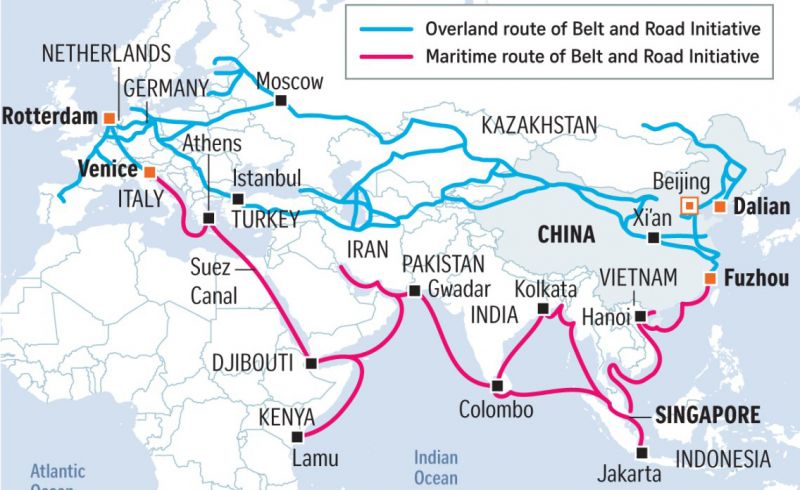
China has gone the extra mile to lend to those countries that don’t have enough money to finance some of the projects (our beloved country Kenya is definitely one of these countries…the SGR). With these, concerns have been raised about the ability of most of these countries to make repayments to China. Case in point, Sri Lanka had to lease its port to a Chinese company after it struggled to make the required repayments. I often hear in matatus people saying that “Kenya tushauzwa kwa Wachina”. We laugh at this but i have a feeling the endgame beckons. Some analysts have echoed this concern saying that this project is just a strategy to lure countries into a debt trap. What do you think dear reader?
Regardless, the projects welcome a lot of positives especially on driving economic growth for respective countries, reducing costs of transporting goods (to and from China especially), making transportation for people easier, ecetera, ecetera…I also choose to appreciate the many positives primarily because i have studied economics and finance, but shingo upande. This can be a China domination in a few years time! This might be a petty reason but just read about the project and share with us your thoughts…have we buckled ourselves to China’s mugithi or is there a brighter future of beautiful roads, fast trains and easier connectivity? And you know, most if not all of these projects will be done by China’s workforce! Ehe…Feel free to share your thoughts.
And a big thank you for reading through😊. See you in the next blog dear reader!

 frank.finance
what a lovely way to bring home the road and belt initiative 1I am curious to see this turn into a series as transport intrigues me
LikeLiked by 1 person